Inkluderingslabbet Toolkit
What if co-created tools allowed an inclusion non-profit to involve actors beyond their own?
.png)
The operator of an autonomous shuttle bus service engaged us to design the Human Machine Interfaces for their new 12-seat vehicle. Existing shuttle buses lack interfaces that provide passengers with critical information during autonomous driving, which can cause discomfort.
Our task was to define guidelines for the vehicle design and create intuitive HMIs that would provide essential information, build passenger trust, and support operators during manual driving. Passengers currently have little awareness of the vehicle's movements and functions, raising concerns about safety and comfort. There is also a need for clear interfaces to facilitate a smooth transition to manual driving when needed.
Our work involved researching autonomous vehicle user experiences, defining guidelines to inform the vehicle's design and development, and creating internal and external HMIs.
The solution involves a set of human-machine interfaces (HMIs) to facilitate communication between passengers, occasional drivers and the autonomous shuttle system.
The HMIs include internal screens to keep passengers informed during their journey, a dashboard for occasional drivers, audio cues, and proposed light animations on an LED strip. The internal screens provide passengers with information tailored to their needs at different stages of the journey. A side screen visually communicates the system's awareness, intentions and context to reassure passengers. During malfunctions, audio messages and microphone/speakers assist passengers. The dashboard provides occasional drivers with separate speed and direction controls. The user interface adapts based on the driving mode. Light animations on an LED strip were proposed to communicate the vehicle's status and intentions to external road users, though this was not implemented.
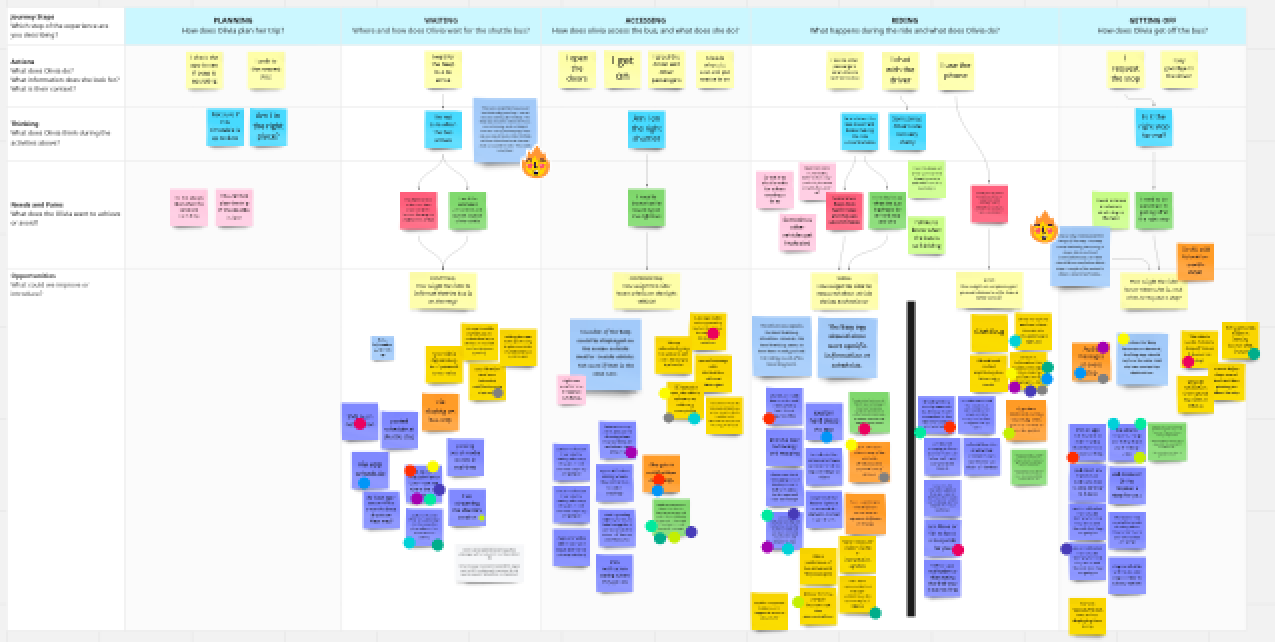
We arrived at this solution through an iterative, user-centered process. We first conducted a literature review to identify design principles and guidelines. We then organized a co-design workshop with end users and experts to generate unified user journeys and visions.We developed an interaction concept with detailed features mapped to user stories derived from research findings and workshop outputs.
Multiple iterations of wireframes and mockups were created and evaluated through user tests with passengers and drivers. Their feedback informed design improvements. Physical and virtual prototyping allowed us to evaluate the effectiveness of concepts before finalizing the solution.This human-centered, research-based approach helped balance the needs of different user groups for a safe, intelligible and trustworthy autonomous shuttle experience. The iterative testing and refining ensured the solution appropriately addresses the identified issues.
.png)
The design research and analysis process resulted in thorough guidelines and concepts for the HMI system for the autonomous shuttle. Different solutions were envisioned for providing passengers and operators with optimal awareness, intention cues and comfort. Visual elements, animations, sounds and interfaces were proposed.
The guidelines and concepts received positive initial feedback from stakeholders and users, confirming they would adequately address usability, safety and passenger trust concerns. Wireframes, screen flows and interactive prototype also demonstrated the potential of the proposed solutions.
However, fully functional prototypes were not developed at this stage, and rigorous testing and validation with real end users was still needed. The research and concept development represent a solid foundation to build upon, to refine and enrich the HMI system through rigorous testing and an iterative design process.
In complex design fields like autonomous vehicles, establishing clear design patterns is difficult as they are still nascent and still developing best practices. For the autonomous shuttle HMI, a lack of established guidelines made envisioning an effective UX challenging. However, a thorough literature review of scientific journals on transport design, human factors and autonomous vehicles formed an essential foundation on which to base the initial concepts and guidelines. An iterative design methodology involving prototyping, user testing and incorporating frequent feedback loops then proved critical to navigate the remaining complexities and refine the HMI system design.
Staying abreast of emerging research topics through literature reviews is critical for design practitioners, providing an evidence-based starting point, especially in fields lacking established patterns.